Author: admin

  • Inspiring Women Leaders – CEO TIME Magazine

    Inspiring Women Leaders – CEO TIME Magazine

    Professor Olga Mroz

    The role of women in life and in business continues to grow and change, experiencing a new round of evolution in our time. The presence of women in leadership positions and their influence on corporate governance, as well as the balance of economic opportunities between men and women, the availability of adequate access for men and women to resources, technology, information and capital, are of exceptional importance throughout the progressive world.

    I was excited, inspired and delighted to be leading a discussion in CEOTIME Magazine, which covers business, technology, marketing and today’s industry.

    A career in my concept is not a high position, a respected company or a position in society. A career is what a person will become and dedicate their entire life to being honest, active and responsible both at work and at home. For me, it’s more of a way of life. “You are special, you are successful!”- my mother used to tell me when I was a child. She believed in my path to success. This feature required a lot of discipline from me. The main factor that influenced my life path and career was education. It allowed me to turn childhood dreams into reality, to understand what kind of person I want to become during my life. I liked to study, read a lot and expand my knowledge.

    At the beginning, I studied architecture, then theatre history, music and art psychology. I was flexible and open for new ideas and challenges.

    Today, I am the Professor, honorary Doctor of Art (DA h.c.) and Director Open World and Art Business Program in Al-Khalifa Business School (AKBS) UK, the Editor and Chief of AKBS Journal. I am also a Board Member delegate of Art and Culture of the Private Council of H.H. Prince Mahmoud Salah Al Din Assaf.

    Al-Khalifa Business School, where I work, is focused on digital learning with a new approach. Online learning is the future of the education system. A modern educational approach combined with the basis of traditional education, i.e., the possibility of personalized learning, gives the possibilities to obtain a high professional qualification to a wider range of students.

    As a director of Open World Program in Al-Khalifa Business School, I work under the supervision of AKBS Chairman and Founder H.E. Professor Sir Manuel Freire-Garabal y Nunez. H.E. Professor Sir Manuel is a lawyer and journalist with an MBA.

    During the acute situation of the Pandemic, we have developed together with Professor Sir Manuel a new project “Art and positive emotions – key success” aimed at improving the work of the team and the working atmosphere in companies. This helped to raise the productivity level and efficiency of firms. The modern world requires radical changes in the management of firms and, above all, in the leaders themselves.

    I would like to note that if we want to make changes, we must change ourselves. We must adapt to the progressive evolution of global information technology. I am proud and enjoy my work. I clearly know that I want to contribute to improve people’s lives, make the world more open. It is very important for me to instil and pass on to the younger generation a love for art, discover and support new talents. It is great importance not only for education but also for teaching young people to form a cultural image, a new leader.

    I am inspired by my work. I have written many articles on the expression and impact of art on our lives. I took part in the international projects – BOOKs “TOUGH ROADS CREATE TOUGH PEOPLE” and „CRACKING THE RICH CODE” and I am officially a #1 international Best-Selling Co-Author.

    My feelings I express on canvas. I am grateful to fate, and I can proudly say that my paintings are in different parts of the globe. Through my paintings, I have the opportunity to evoke feelings, evoke positive emotions, bring joy to people and influence the improvement of life on our planet. My own belief in the effectiveness of my actions enables me to achieve more professional success. It motivates me to put in even more effort. Therefore, I need success as a motivation for my growth as a person and as an outlet for global success.

    My contributions to education and social welfare, and participation in major conferences such as World No. 1 Ritossa Global Family Office Investment Conference, where World Leaders and Elite Family Office Investors unite together to invest and create a Brighter Future, inspire me allow me to positively impact the global improvement of life.

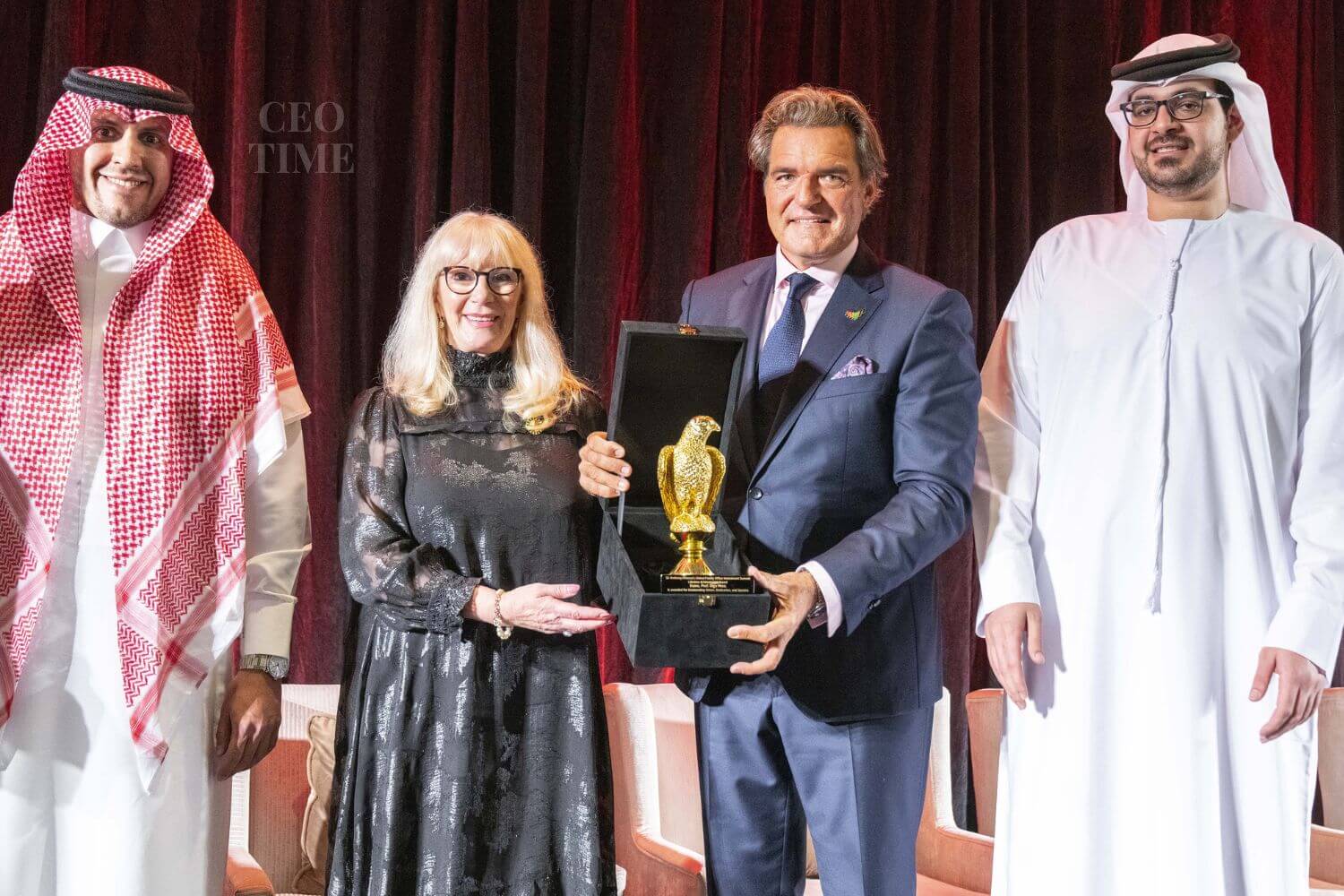
    I am very humbled and honoured that I have been awarded for outstanding vision, dedication, and success und also for the extraordinary leadership and advisory skills, excellent cooperation and support to Global Family and the Royal office. It is a great pride that I am recognized among 50 outstanding women from around the world in “Powerhouse Global Stars 2021”, received the Award “GLOBAL IMPACT LEADER of the Year 2022” and recognised by Powerhouse Global as “THE DIFFERENCE MAKER IN THE WORLD”.

    The TYCOON SUCCESS Magazine recognized me as one of “The 10 Most Remarkable Business Leaders, Ruling the Modern Industry in 2022”. These awards and recognition as a global leader require me to take even greater responsibility and activity.

    As a professor at the Al-Khalifa Business School, I am pleased to be able to contribute to the topic of women’s education. The education of women is the key to a better balance between men and women in the workplace, one of the most important issues in gender politics.

    I pay a lot of attention to topics that excite me, including “Women Empowerment” and I often speak at conferences on this topic. I gave a speech at the world Life Webinar, in which 148 speakers from 47 countries of the world took part. I have a certificate from the World Book of Records. In the Europa conference IME I participate annually as a speaker in the panel discussion “Gender empowerment” and have awards in these categories.

    I started my great career as a musical theatre director. At the time, I was the only female director. It was not easy for me to work with the great conductors and to make my decisions. But through my activities, right actions, innovations that led to success, I was able to prove that women are important in leadership positions too.

    I take this opportunity to urge all Women to stay eager for knowledge. I would like to emphasize once again that it is very important not to stand still, but to constantly move forward and to keep developing and learning. And under no circumstances should you sacrifice your own family. If the word “victim” stands between family and career, if a woman is successful but unhappy at the same time, then it is not a real success.

    I think is a successful woman who not only feels happy, but also makes other people happy.

    I am blessed, I will be speaking at the Powerhouse Global Women Retreat/Summit/Awards in September 2022 in UK alongside some of the best women leaders from around the world. They have become incredible role models for women and girls and serve as an inspiration around the world. I am honoured to meet the First Female President of the Republic of Mauritius H.E. Ameenah Gurib-Fakim. We will spend three active and productive days together.

    I painted my painting “Women of Universe” last year. Women are small rays in the universe. They give love, light and peace to all. Women are energy from Space, they are achievements, visionaries, Women are Family and Life.!!! Women are an epitome of beauty, strength, wisdom, and care. They are the light that shines bright, have the power to lead, beauty to nurture, and love to care. Women are the real architects and sustaining force of any society.

    The great Japanese writer and feminist, Raicho Hiratsuka, once famously wrote: “In the beginning, woman was truly the sun. An authentic person”. Today more than ever, the global economy needs precisely this kind of radiant sun to provide light. To bring a ray of equality, removing all existing inequalities.

    Dear women, you are all the sun, and you shine your lights into the world. Thank you all for your commitment and passion.

  • Sandra Tricoli

    Sandra Tricoli

    • How would you describe your journey? Brief us on the inception story of your career. My journey started back in 2015 when I got made redundant . I knew this was an opportunity to finally step out on my own and start my own business. I didn’t want to let anyone determine my destiny other than myself and I knew that working for myself would let me be in control of my life, my finances and my life by my design.
    • Enlighten us about your role in the organisation you are leading / associated with? I am the Managing Director of Savvy Creations PR which is a PR and Social media marketing agency. We help clients grow their authority and digital footprint through the use of social media. In todays tech savvy world it is more important than ever for businesses to have their own voice and to be able to share this online. We are passionate about our clients growing their business to new heights.
    • Where do you find inspiration? What motivates you to work harder? My inspiration comes from my overarching mission which is to help people. I think if you have money as your main source of inspiration then that will fizzle out, your inspiration needs to be backed by have a stronger mission. My inspiration is also derived from other woman and seeing the amazing things that they have been able to achieve .
    • Kindly mention some of the notable recognitions and accreditations received by your person. I was nominated as a Woman of the future a few years ago
    • What is the one thing you wish you had known about women in your line of work before you started working? Things take time, success takes time. Its easy to look at woman in your line of work, or any work for that matter that have succeeded and to compare yourself, but the reality is success takes time and it’s an ongoing journey. It’s important to stay within your own lane and focus on your own goals and try and not get too distracted by external factors. Business and success takes time and I think in society today we want everything right now but having a 5-10 year strategy is vital to keeping you on track with where you want your business to go.
    • Do you believe it is compulsory for a woman to manage a household alongside her work? Absolutely not, it should be a shared role with the partner. Most woman and men work full time today therefore the household tasks should be managed equally. The stereotype of woman should cook and clean and do everything is definitely one of a dying age, all roles should be shared equally within a household.
    • As a woman, what has been the highlight of you career? What are the changes you wish to make for the better in your professional life post-pandemic?

    The highlight in my career is that I have been able to grow my business beyond what I thought was possible when I started. The woman I have become through the process of running my business is far greater than any financial success or accreditations that I have obtained throughout the years. I have also had a beautiful daughter who is now 3.5 years so being able to juggle a business and motherhood has been a big highlight to my life not just my career.

    Its not so much any changes that I want to make but rather a continuation of being the best me through education and training. I am always reading books, attending seminars and webinars in order to stay up to date with what is happening around the world. For me I look at it like it’s my obligation to be my best self so that I can serve my family, my staff and my clients at the highest standards.

    Brief us on the changes the pandemic brought to your sector and your market. Has the work-culture altered? There has been an increase in people understanding the importance of going digital. Before the pandemic some people were on the fence about “ do we need social media” to grow our business but during and after the pandemic most people realise that yes we need to have an online presence as this is where peoples attention is . My business grew by 50% in the last 2 years as the demand for online presence increased greatly.

    People are also a lot more happy to have meetings online rather than in person so the way that we conduct meetings has definitely changed and people have become a bit more relaxed in that sense.

    • What words of wisdom/ inspiration/ advice would you offer to the next generation of female leaders?
    • Don’t ever settle for anything less than what you know you were meant to do in this world. The strong voice in your head that is telling you ‘ there is something bigger and better for you” needs to be listened to. Every single hurdle and mistake that you have encountered has strengthened you to become the woman you were meant to become. Don’t let any rejection put you down and make you question your worth, remember rejection leads to redirection and it’s the universe pushing you in the way that you are meant to follow.
    • Another bit of advice is to not get too impacted by external factors, don’t try and do what everyone else is doing, but rather do it your way.

    Another bit of advice is NEVER stop learning. Life and business is an ongoing process and even when you reach the level of success you are desiring you owe it to yourself and to those around you to keep learning and keep growing.

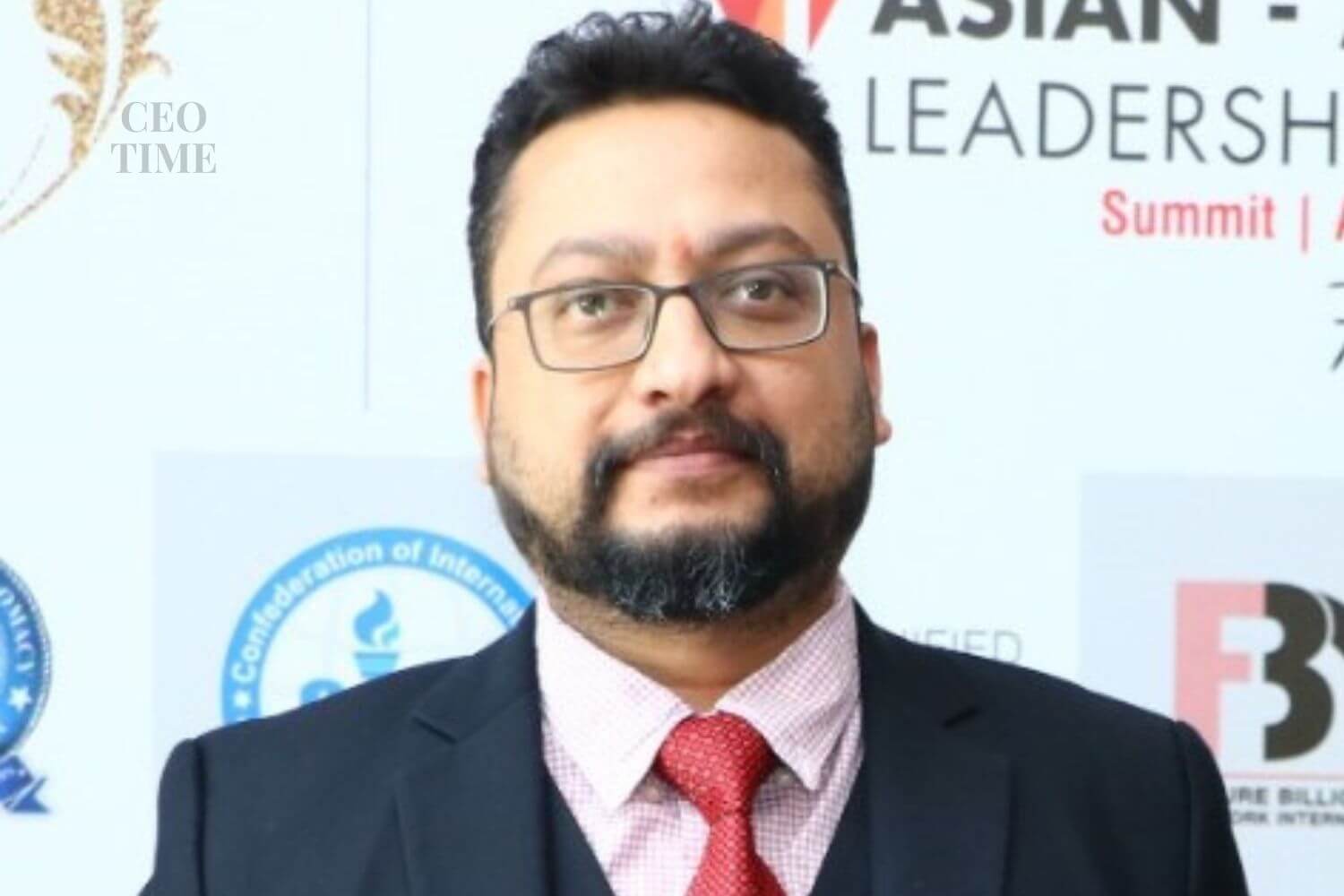
  • Rajiv Dalmia

    Rajiv Dalmia

    With a humble start with multiple part-time jobs from the age of 16 to support his own studies and his only ambition being to be able to be anything like Mr. Ratan Tata, RD started learning the game of the corporate world.

    RD strongly believes that people Buy from People – Trust & Relationship is all that matters. To solve not sell, future relevance, a sense of ownership, continuous learning, respect for time, integrity, sincerity & proactiveness are what drives him.

    RD as an innovative leader, keeps himself appraised of all the latest happenings globally and constantly keeps learning One New Skill every day, thereby being an inspiration to many to innovate, to think outside the box & to constantly learn.

    Rajiv (RD) is an extremely accomplished Executive Leader, Strategist. “Future Relevant” Evangelist. Guest Lecturer. Mentor. Author of multiple Whitepapers, Articles, Blogs, and Videos. Mentoring & supporting various meaningful communities and organizations in various capacities like Most Promising Thought Leader of the Year by Asian African Leadership Forum, Global Mentor of Change at GCPIT-GCCER-UFIRST, and as Accomplished Global Leader featured in “28COE”, “The 28 credentials of an entrepreneur”, “90 DAY SUCCESS THERAPY”, the “Signature Book” and the famed collection will gradually go onto “Malaysian Book of Records”, CEO Club Global, Official UNICEF Member, ANZ India Business Chamber member, Lifetime Honorary Position of “Board Advisor” to the Governing Council of Asian-African Chamber Of Commerce & Industry – (AACCI), Senior Mentor with Indywise and many more.

    With his experience across 100+ countries and almost all industries, he is an institution in itself, to learn in every interaction with him.

    His advice to budding entrepreneurs is –

    1. Love the problem not the solution
    2. There is no right time to be PERFECT – Launch/Start Quickly – Learn – Improvise – Relaunch
    3. It’s either Cost or Quality leadership – do not mix, no midway
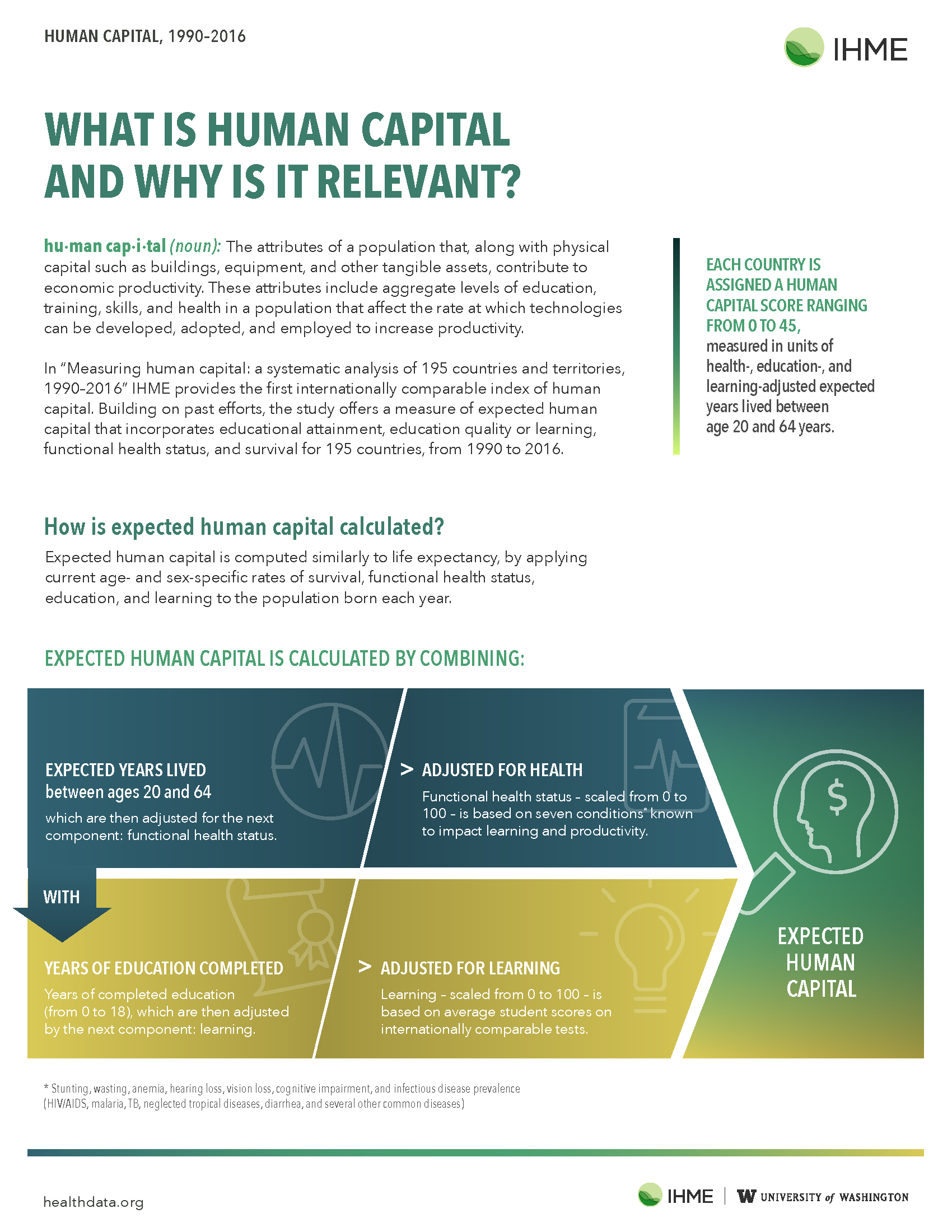
  • Study: The US ranks 27th in education and health care

    Study: The US ranks 27th in education and health care

    The study, conducted by the Institute for Health Metrics and Evaluation at the University of Washington, attempts to measure “human capital”: a metric that describes “the attributes of a population that, along with physical capital such as buildings, equipment, and other tangible assets, contribute to economic productivity.” It is defined, in context of this study, as “expected years lived between the ages of 20 and 64,” adjusted for functional health status and education, or “learning.”

    Essentially, it pinpoints the number of years an adult can be working at their peak — before learning gaps or health issues slow them down. The results don’t just tell us who is working at their peak, they can also give us some reflections about how governments can help their citizens reach their individual potential, which in turn helps a country’s economic output.

    “It is a concept that recognized that not all labor is equal, and the quality of workers can be improved by investing in them,” a presentation from the institute reads.

    What is human capital?

    In order to measure the idea of “human capital,” researchers started with a base number: 45. That’s the highest possible value, meaning a person was working at peak productivity from the second they turned 20 to their hypothetical retirement at the end of 64. In other words, basically impossible.

    They then adjusted for education and health by creating values from test scores and the prevalence of common diseases.

    “We estimated educational attainment using 2,522 censuses and household surveys; we based learning estimates on 1,894 tests among school-aged children,” the study’s abstract reads. “And we based functional health status on the prevalence of seven health conditions, which were taken from the Global Burden of Diseases, Injuries, and Risk Factors Study 2016.”

    The result is a number, lower than 45 but higher than zero, that estimates in years a person’s peak productivity.

    What the results reveal

    According to 2016 data, the top rankers in terms of human capital were Finland, with 28 years; Iceland, Denmark and the Netherlands with 27; and Taiwan and South Korea with 26. The bottom rankers were Niger, Chad and South Sudan, all with three expected years of human capital.

    Of the 195 countries tested, the United States clocked in at 27th, with 23 expected years of human capital. However, in 1990, the United States ranked sixth in the world. Curiously, the number of years of human capital expected of a US citizen in 1990 was 22 — one year less than the current expectation.

    So why the precipitous fall? The institute characterizes it as a stagnation “due in part to a lack of improvement in years of education attained.”

  • It’s time for SA to embrace a new healthcare model

    It’s time for SA to embrace a new healthcare model

    The National Health Insurance (NHI) is not a radical shift to dismantle a functioning system, but an opportunity to review two poorly functioning ones. The public sector sees very high volumes of patients but gives them bad service and produces very poor outcomes. The private sector is modeled on low-volume, high-cost care — it uses its huge quantities of resources badly, to service very few people.

    As the health market inquiry report makes clear, the large, commercial medical schemes are resisting needed reforms which, with better productivity, would lead to the convergence of the two systems. In particular, they persist with an outdated tariff system that pays for services, not outcomes, and doesn’t support team-based delivery models. This is probably because it threatens their claim payment and “managed care” models that justify a very high income. This strategy is counterproductive for their members.

    SA cannot move forward socially or economically without convergence. We need a high functioning universal healthcare system — one that can provide high volumes of quality care at low cost. One that uses all available resources, assigns funding according to need and rewards value (the best outcomes, at the lowest costs) when it is delivered.

    The challenge for all stakeholders is how best to transition to such a system,  one that places patients at the centre of its model, with service by multi-disciplinary teams providing continual and proactive care. The transition must be compelling and safe for clinicians. It must be an attractive vision, have realistic milestones and pose no threat to clinician income. It must produce a system that is affordable for all South Africans.

    No value for money

    This is what the NHI proposes to do: it has as its premise the separation of the supply of healthcare from the role of an agency purchasing it, in line with international best practice. Since 2000, medical schemes have been cast the role of purchaser, but none has taken it beyond pursuing good prices from providers. Instead of actively commissioned, new, highly productive models, they have overseen rapidly rising premiums. The health market inquiry report vividly describes how schemes have failed their members by not buying overall value for money, despite the reform road being perfectly clear.

    The purchaser role put forward by the NHI is the proper one, however, with providers competing for contracts from a large purchaser based on the value they deliver. It sets out to quickly drive vast improvements in how care is delivered to bring down the cost of comprehensive medical care. It plans for a major shift towards community-based care, instead of today’s hospital plans. And it supports widespread multi-disciplinary teamwork, a much more effective and cost-efficient model.

    The NHI is not a move to dismantle the commercial sector, it’s a call to action for much-needed reforms. A commercial sector that offers high-value services will provide them for an NHI purchaser, which has no preference for publicly owned, commercial or not-for-profit providers. Made subject to market competition, public-sector services will need to tremendously improve their delivery of care or face losing their funding.

    We need to acknowledge that, as it currently stands, neither system produces good value, essentially because they are badly structured. They are built around the convenience of clinicians — bringing sick patients to multiple hospitals, clinics or private rooms for care. Doctors are paid and work as individuals, which hinders multi-disciplinary input and results in reactive rather than proactive healthcare. Both systems have poor process management, which cannot manage patients with multiple problems. In different ways, both have badly misaligned incentives for the practitioners who work within them.

    Healthcare stakeholders must get out of the weeds and stop resisting change by disputing unspecified details of the proposed NHI. Stakeholders should be urged to rather embrace the NHI framework as a step in the right direction, one that will spur the sector to action, and out of its current stasis.

  • Automation: Robots are coming to snatch your jobs

    Automation: Robots are coming to snatch your jobs

    Though a 2013 Oxford study mentioned that almost 50 per cent of all US jobs could be computerised within 20 years, 63 per cent of respondents to a Monster.com survey felt nothing could take away their jobs in the next 50 years or so. This shows that too many people are unaware of the automation wave that is coming soon.

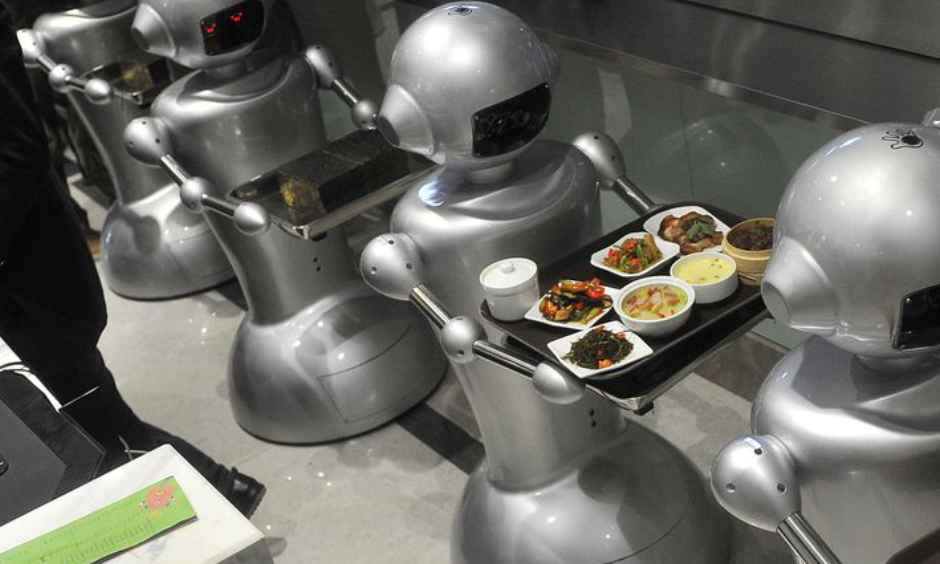
    Food service and manufacturing are predicted to be the first job industries which would be taken over by robots and AI for the most part. If some industries get highly automated, the other fields are bound to get affected too. Employees need to re-skill themselves and fast!

    “Recently, the Indian banking system has seen the beginning of the revolution. Robots also make burgers and do all kinds of middle tasks, leaving behind only entrepreneurship or a temporary staffing. Artificial intelligence manages investments, handles everything like insurance claims and basic bookkeeping, and performs basic HR tasks,” says Avinash Bharwani, Vice President- New Business, Jetking.

    It is your soft skills which will become extremely valuable when AI, automation or robots enter the job market. With the high pace at which new technologies are coming to the fore, we need to ask ourselves whether our work could be done by a robot. And if it can, we need to get worried.

    The main jobs which will face a great automation risk include factory workers, drivers, cashiers, waiters and customer service personnel.

    Which jobs are safe from automation and robots?

    • Creative jobs such as those of artists, designers, hairdressers, writers etc are safe as automation cannot replace true creativity
    • Those jobs where humans display their skills such as that of a sportsperson, singer or dancer will be safe as no one would enjoy robots competing against each other or marvel at a completely artificial voice
    • Jobs requiring empathy such as those of counsellors or therapists will be retained by humans. This category could also include to some extent teachers, vets, dentists, fitness trainers, police officers, fire-fighters etc
    • Jobs where you would need to cater to specific bits of knowledge such as that of tour guides or florists cannot be taken up by robots
    • Jobs which involve creating, maintaining or fixing automation or AI technology would also be safe from robots
    • This shows that while some jobs will be eliminated, many employees will find themselves becoming overseers to AI

    Here are a few tips on how you can protect your job from automation and robots:

    1. Be aware of how much automation risk you face

    Do adequate research in your job field to understand if you should be worried about AI or robots taking over your job. List your skills and check whether any of them could be done by robots. Job skills which deal with people or need you to innovate and come up with new ideas are less likely to be automated. So, focus on enhancing these soft skills to safeguard your job from robots or automation in future.

    1. Understand partial automation

    It is quite possible that only a part of your job, such as inputting data and info onto spreadsheets, will be automated, which can actually boost your productivity. Often, employees spend a large chunk of their allotted work hours doing menial, routine jobs which do not utilise the human mind adequately. These routine jobs will be dealt with by using automation software, AI and robots. You need to make sure that your top job skills are polished and possess a human touch.

    1. Work beyond your job description

    To make yourself more valuable to your company, have a decent idea on how the rest of the departments work. Understand the goals of the company and increase your area of expertise so that if your job in under the threat of being taken over by automation, AI or robots, you have other options to bank on.

    1. Look for a career move

    If per chance you realise that your job will definitely be taken over by robots or automation and there is nothing you can do to change that, start looking for a different job which uses slightly different job skills that cannot be automated. Re-skill yourself accordingly – you can go for short certificate courses or sign up for a free course on Coursera, EdX or yet another MOOC website. Some companies also provide tuition reimbursement to employees looking to skill themselves further.

    The automation wave would definitely help push forward human productivity to a great extent and the increasing proliferation of AI and robots is actually a great boon. “Artificial Intelligence is making technology more helpful and intuitive. And this is most evident in the smart-phone market. A phone that can learn your language, count your calories, answer your questions or recognize what a things look like,” says Jetking’s Bharwani.

    India and automation

    India too needs to join the rest of the world in pushing its way forward in the field of artificial intelligence. “China has progressed in AI-based research; India should also view

    AI as a critical element of national security strategy. India needs to be prepared for the digitalised future. Establishing AI-ready infrastructure, digital services and digital literacy is thus necessary to prepare India’s jobs and skills markets for an AI-based future. The bold urban initiative by government called ‘Smart Cities’ is also giving a hint to the public to stay ready,” says Bharwani.

    The skills, experience and insight that a human being can provide are irreplaceable. Soft skills are the skills of the future. Machines and robots would only be taking over those jobs which are suitable for them.

    As Bharwani says, “I believe the time is not far when the robots takeover workplaces and hence it is necessary to know how humans are required to handle them. AI is no more a toddler. Many AI researchers believe that the day will ultimately come. The question is, are humans ready for it?”

  • Why B-School is initiating teaching Artificial Intelligence and Machine Learning

    Why B-School is initiating teaching Artificial Intelligence and Machine Learning

    There is no doubt that Artificial Intelligence (AI) and Machine Learning (ML) are the two hot buzzwords right now. Examples of how AI and ML based disruptive practices are replacing traditional businesses on one hand while creating new business opportunities, on the other hand, are many.

    In a nutshell, AI is the broader concept of machines being able to carry out tasks in a ‘smart’ way while ML prescribes the set of such ‘smart’ rules that the computer figures itself out.

    2 lakh new jobs coming up in Artificial Intelligence sector

    It is no exaggeration to say the current and the future belongs to AI and ML. It is estimated that in USA, there are more than 10,000 positions available at top employers across the country and additionally, the country is estimated to have 2, 50,000 open data science jobs by 2024.

    Elsewhere — in EU, Canada and China — the demand for AI related jobs are not only in high demand, they are a few notches above the median salary.

    India too is not far behind other countries in terms of AI hiring. Some estimates expect a 60 per cent rise by this year due to increasing adoption of automation, and the related IT industry will require 50 per cent more workforces equipped with digital skills.

    All this translates to around 2 lakh new jobs this year.

    Educational institutes need to provide future AI employees

    Obviously, where the demand is there, educational institutes are expected to be at the forefront in bridging the gap. The question is — why are AI and ML finding its way into the B-school curriculum when it appears that AI and ML are still the forte of computer scientists, programmers and mathematicians?

    Almost all of the top 20 business schools in India are now offering specialisations in Business Analytics while some of them are offering specialisation tracks in AI ML.

    The answer is evident if we closely inspect two things:

    • One – what does AI ML typically do or can do?
    • Two — what are the expected roles of business schools?

    Decision-making based on data inputs isn’t anything new: Benefits of AI and ML

    To understand what AI and ML bring, we must acknowledge that decision-making based on data inputs isn’t new. Indeed, the traditional courses offered in B-schools related to decision sciences used computational algorithms as well as statistical models to solve problems.

    Most of these algorithms are over a century old. However, our getting to a solution was limited by the way we deemed fit to go about it.

    For example, logistic regressions, the favourite technique for many to solve binary classification problems (problems that needed us to correctly predict one group from the other), required us not only to identify the factors but also how they must be related to each other.

    Undiscovered and hidden patterns in the data eluded us. ML solved this by letting the algorithms learn on its own, from the data and from itself the best route to classify.

    Thus, the various boosting models, ensemble techniques as well as neural network models connected dots in the data which improved upon the results traditional algorithms could not.

    The second finesse AI and ML brought are the unstructured data. This is what defines them and has not only gives us additional insights, it helps us address and tackle issues which otherwise we struggled with.

    We now solve traditional problems using data obtained from video cameras, speeches, texts, social media interactions, images, satellite images etc. We no longer need to only focus on historical data to gauge stock market sentiments, often analysing texts in shareholder reports gives us better accuracy.

    To estimate the footfalls in shopping malls, traditional survey methods are getting replaced by images of cars in car parks, to design agricultural forward contracts, satellite images of agricultural plots provide invaluable information.

    Simply put, AI and ML have allowed us to access, process and utilize data in an efficient way to solve complex problems – both traditional as well as those posed in the new ecosystem. This is where B-schools fit in, almost by design.

    B-school curriculums have always pride themselves for creating efficient decision makers. Managers are expected to decide and then execute their decisions. Often, such decisions must be made based on limited data and experience and yet must be made quickly.

    It is not surprising, therefore, that some of those decisions face ex-post criticism, and perhaps rightly so. Decisions based on AI-ML are likely to reduce such errors.

    For one, most of the unstructured data are not open to manipulations, and two, analysis based on that data reduces the human bias largely.

    What is missing with AI and ML: the power of human intuition

    However, there is an intrinsic part of human decision making that can’t be separated — intuition.

    To a machine, a data is a set of numbers arranged in rows and columns where the column headings have no meaning! To a manager, the column headings are the most important. It is his training and experience that allows him to retain what is essential and cull out the rest.

    Unlike a data scientist, whose journey with ML techniques is almost entirely about the column headings, he can trade-off accuracy for insight.

    For example, an ML technique may always pick up ethnicity of an individual to determine whether he is worthy of receiving a loan, but a manager can use insights to exclude ethnicity as it may violate some fundamental principles!

    A successful AI ML programme in B-schools must ensure that this balance stays. Curriculums must focus on ML techniques complimenting the managerial decision and not substitute them.

    While Indian business schools were reasonably slow in riding the business analytics wave, it appears they want to remain ahead of the AI ML curve this time.

  • WHAT TO DO WITH YOUR IMAGINATION

    WHAT TO DO WITH YOUR IMAGINATION

    We all have imagination capabilities, it depends whether we choose it to imagine or not. You are always free to imagine without any interruptions. As it is a mingle-mind process, you can simply close your eyelids and imagine anything, that’s it. That’s how we can realize Imagination Power, which is perhaps supernatural as it completely exists in a dream world, not in reality. Imagination can be said as a natural breathing for us.

    It has been scientifically proven that the boundaries of imagination are just our past memories and experiences.  Creativeness which grows out of our mind is the result of imagination and can be termed as our ability to mix a number of existing principles or concepts put them in arranged order to look at something new or different from the world.

    That famous Apple motto of the late 1990s harks true: think differently.

    Thinking differently is not only restricted to highly sharp or quick-witted capable geniuses. Imagination helps in improving knowledge which is then applicable in solving problems and is fundamental to integrating experience and the learning process. You can imagine wherever you want; it can be a workplace, a playground, while bathing, etc.

  • SMALL CHANGES HAVE REALLY PROFOUND IMPACT

    SMALL CHANGES HAVE REALLY PROFOUND IMPACT

    Sometimes in our life small and almost less changes can have major impact. Right starting from thinking about a problem to a point of observing someone, delicacies play a very crucial role.

    The reason being celebrating the bigger  changes— invention of a plane or the moving to vehicles from old-age wagons , over the smaller ones—wearing a fashionable shirt, taking up new attires or goggles or making a new  cartoon character out of our creativity —is because little or changes at lower level  are pretty much at ease.

    You don’t have to put in much to incorporate little changes. Even then, we usually tend to ignore making these little changes by giving indefinite reasons like if it is easy to do, it’s not that much important.

    Yes! Many of us can easily see, this is not the case. Taking creativeness into consideration one should not need to focus on larger or big changes or challenging problems in life; but foresee that what little changes you can make now onwards, then make them. Considering them not easy, but focusing on what changes it has made to a situation irrespective of its previous condition.

    Image URL: https://unsplash.com/photos/Ra_XAMExk8c

  • SHARING IDEAS ARE MAKING MORE SENSE THAN SHELTERING

    SHARING IDEAS ARE MAKING MORE SENSE THAN SHELTERING

    We usually hide our ideas out of fear as they can be apart before they’ve had a chance to shine. We always keep our ideas in a perfectly polished condition before we start sharing them with the world, before keeping things in the way which could bring the revolution to a greater extent. We always fear condemnation and perhaps think that our mind-blowing ideas aren’t that much great to be applied for.

    If we thought our ideas step out of our capabilities, desires, quotient; then we should always keep in mind that it would be always the scariest or worst thing to be revealed in front of others. From others, at last, we expect that we’re not that much intelligent or capable enough to handle or we tried to prove something as superlative which is obvious for many of us. As we don’t want to showcase ourselves as fool or wrong, we cover our ideas from the world until we get a good stage to put forward it.

    We should understand that ideas can never be great enough unless and until they face denunciation from outside world or fall under this human world point of view. As far as an idea is in our mind, it is termed as good or mind-blowing. Once an idea is revealed in the world then it can be grown or strengthened to a maximum extent so as to bring best out of it.

    Image URL:  https://unsplash.com/photos/C-v1p2DTakA